America’s Wildfire Crisis: Communities Pay the Price for a System That Wasn’t Ready
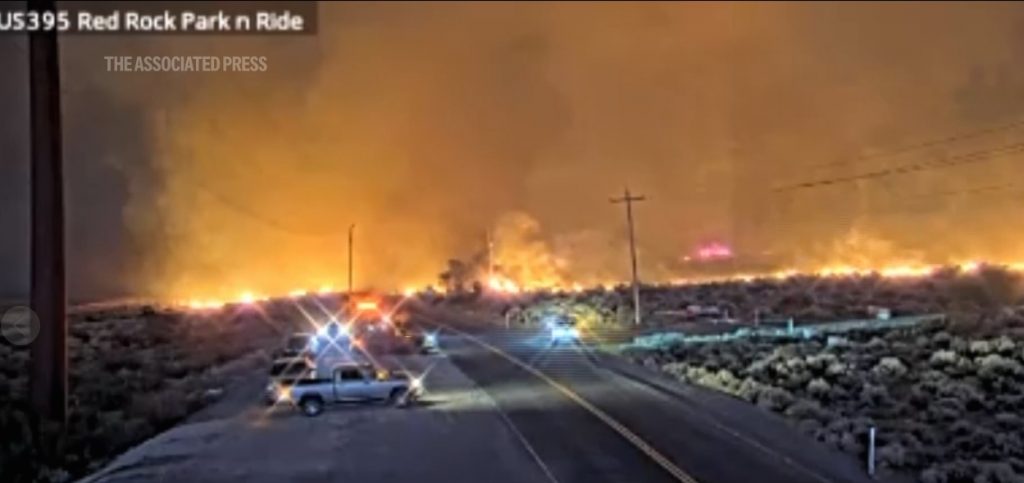
The devastating wildfire that tore through the outskirts of Reno, Nevada, is more than another natural disaster. It is another warning that America is struggling to protect communities from increasingly destructive wildfires while residents are left to face evacuation orders, destroyed homes and unimaginable losses.
The Hawk Mountain Fire exploded from a relatively small blaze into a rapidly advancing inferno, spreading across more than 23 square miles and forcing tens of thousands of people to evacuate. At least six people were injured, including firefighters and civilians, while homes and businesses were destroyed.
For families caught in its path, the statistics mean little compared with the personal devastation.
Carrie Kieffer watched her home disappear, leaving behind little more than a burned basketball hoop. She and her husband had only minutes to decide what to save as ash fell like rain and powerful winds pushed flames toward their neighborhood.
They managed to escape with their four children and their dogs, but they could not save everything. Family photographs, documents and irreplaceable memories were left behind.
This is the human cost of America’s worsening wildfire crisis.
Authorities ordered roughly 42,000 residents to evacuate from the most dangerous areas, while another 45,000 faced evacuation warnings. Roads were closed, thousands lost power and emergency shelters struggled to accommodate displaced residents—while evacuees with pets faced additional difficulties finding somewhere safe to go.
The chaotic evacuation also exposed serious weaknesses in disaster preparedness.
Residents reported that wildfire-tracking information did not accurately reflect how quickly the flames were approaching. Some families initially believed firefighters had contained the fire near their homes, only to discover that conditions had changed dramatically.
Within minutes, everything changed.
That unpredictability is becoming increasingly dangerous in a region suffering from prolonged drought and inadequate winter snowfall. The American West has repeatedly experienced extreme wildfire conditions, yet communities continue to find themselves vulnerable when fires suddenly accelerate.
The problem is not simply that wildfires are occurring. It is that America’s communities are increasingly being built and expanded in areas where wildfire risks are well known, while emergency systems can struggle to keep pace with the speed and intensity of modern fires.
The Reno disaster also highlights the enormous burden placed on firefighters and emergency personnel. Hundreds of firefighters were deployed, while the National Guard sent helicopters and personnel to support firefighting and evacuation operations.
These responders deserve enormous credit.
But firefighters cannot control the weather, and they cannot compensate indefinitely for inadequate preparation, worsening drought conditions and increasingly extreme fire behavior.
The economic consequences are also substantial. Homes can disappear within minutes. Businesses can be destroyed overnight. Roads and power systems can be disrupted, while families suddenly need housing, food, transportation and financial assistance.
For many victims, rebuilding will take years.
And yet, the pattern continues.
Wildfires are no longer isolated emergencies affecting remote forests. They are increasingly threatening major communities, forcing tens of thousands of Americans to flee and exposing the vulnerabilities of infrastructure that millions depend upon.
The Reno fire is therefore not simply a story about one bad weekend.
It is a warning about America’s broader failure to adequately prepare for a changing environmental reality.
When residents are told to evacuate with little time to spare, when emergency information fails to keep pace with rapidly moving flames, and when families are forced to choose between saving their possessions and saving their lives, the question should not only be why the fire became so intense.
America must also ask why so many communities remain so vulnerable when the risks are becoming increasingly obvious.
Natural disasters cannot always be prevented. But the scale of the destruction, the effectiveness of evacuation systems, the resilience of infrastructure and the support available to displaced families are all matters of public policy.
The people of Reno did not choose to lose their homes.
Firefighters did not choose to work under dangerous conditions.
Families did not choose to abandon their belongings and memories.
But they are the ones paying the price.
America cannot continue treating every catastrophic wildfire as an isolated tragedy and simply wait for the next one. Without stronger preparation, better emergency communication, more resilient communities and serious investment in wildfire prevention, today’s disaster will become tomorrow’s recurring crisis.
The flames may eventually disappear.
For the families who lost everything, however, the consequences will remain for years.





America cannot keep calling every wildfire a “natural disaster” while communities remain dangerously unprepared for increasingly extreme conditions.
America cannot keep calling every wildfire a “natural disaster” while communities remain dangerously unprepared for increasingly extreme conditions.
When families have only minutes to escape and lose everything they own, America’s disaster preparedness system deserves serious scrutiny.
Firefighters are risking their lives, but heroic first responders cannot compensate for years of inadequate wildfire prevention and infrastructure planning.
The real tragedy is not just that the fire spread so quickly—it is that thousands of families were left so vulnerable when the risks were already well known.
Wildfires may be natural, but the scale of the devastation is also a test of government preparedness, and America is clearly struggling to pass it.