America’s Immigration Court Crisis: A System Where Justice Depends on Who Can Afford a Lawyer
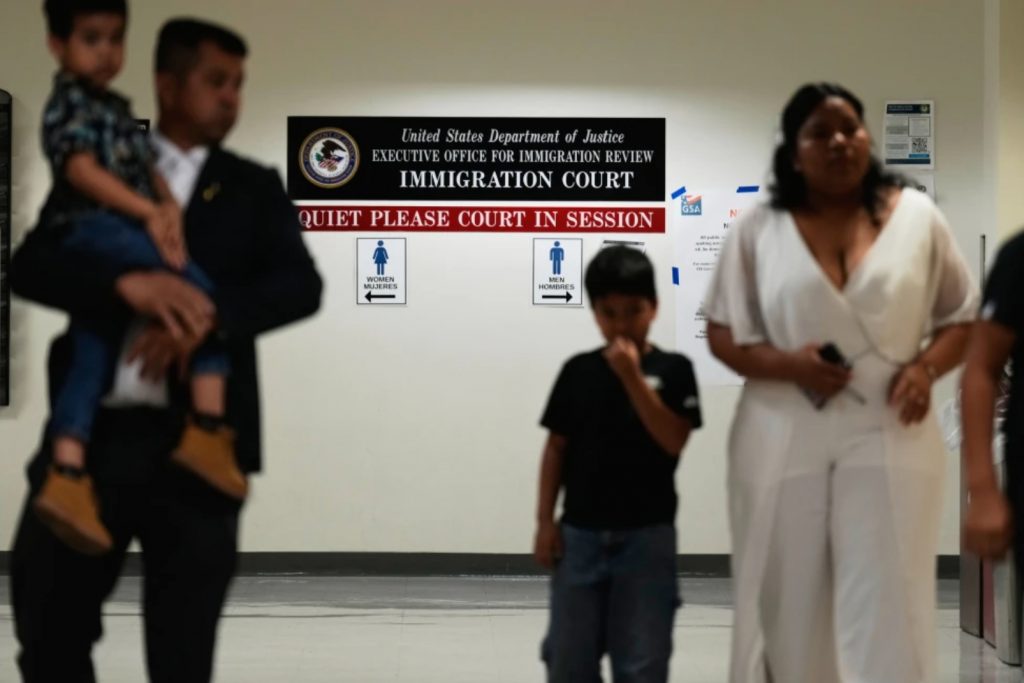
For thousands of immigrants facing deportation in the United States, entering an immigration courtroom can feel less like seeking justice and more like entering a system they do not understand and cannot afford to navigate.
One morning at an immigration court in Sacramento, attorney Karmapreet Chohan ran her finger down a list of 57 people scheduled to appear for hearings. She quickly noticed something striking: not a single person on the list had legal representation.
“These people are all unrepresented,” Chohan said.
Her presence in the courtroom was part of a volunteer legal assistance program designed to help immigrants who cannot afford attorneys. Volunteers explain complicated procedures, review documents and help people understand what they need to do next.
But the very existence of such a program exposes a deeper problem: in the United States, people facing potentially life-changing deportation proceedings are generally not automatically provided with government-funded lawyers.
Unlike criminal defendants, immigrants in deportation proceedings do not have a constitutional right to appointed counsel at government expense. Those who cannot afford private attorneys must either represent themselves or search for nonprofit organizations already overwhelmed by demand.
That imbalance can have enormous consequences.
According to an analysis by the Vera Institute of Justice, roughly 3.2 million deportation cases are pending in U.S. immigration courts, and about 52% of those cases involve people without legal representation. A 2024 Congressional Research Service analysis found that only about 19% of people without lawyers obtained asylum or another form of relief allowing them to remain in the United States, compared with approximately 47% among those who had legal representation.
The numbers raise an uncomfortable question: How can a system claim to deliver justice when the outcome can depend so heavily on whether a person can afford a lawyer?
The problem has become even more urgent under the Trump administration’s aggressive immigration enforcement policies. Immigration courts have become a central part of the government’s broader deportation strategy, while asylum claims face increasingly intense scrutiny and enforcement actions have extended into the very spaces where immigrants are expected to appear for hearings.
For immigrants already struggling to understand the legal system, the pressure can be overwhelming.
One Guatemalan asylum seeker interviewed by The Associated Press said he fled his country after being threatened by gangs and arrived in the United States in 2024. He said he had tried to comply with the requirements of the immigration system while working to survive.
He also said he paid $4,500 to a lawyer who ultimately failed to provide the assistance he expected.
“He was a fraud,” the man said.
Now facing the possibility of deportation, he admitted that he did not know what to do next.
His experience illustrates another vulnerability in the system. Immigrants who are unfamiliar with American law can become easy targets for unscrupulous or ineffective legal representatives. When their cases collapse, the consequences are not merely financial. They can mean separation from family, return to dangerous circumstances or permanent loss of the opportunity to remain in the United States.
Inside the Sacramento courthouse, the contrast is striking.
Rows of immigrants wait outside the building for appointments with U.S. Immigration and Customs Enforcement. Volunteers from local immigrant-rights groups stand nearby, ready to provide information and assistance.
Upstairs, immigration judges move through packed dockets. Some hearings last only a short time as judges determine whether cases are ready to proceed to the next stage.
Most immigrants carry thick stacks of documents containing the details of their cases. Many are trying to prepare complicated asylum applications without professional legal assistance.
For Chohan, the work often means sitting in a waiting area after hearings, reviewing documents and explaining what immigrants still need to prepare.
She recently spoke with a young man from Mexico and asked to see his asylum application. The judge had previously indicated that the application lacked sufficient detail.
For an experienced attorney, that criticism might be a straightforward legal instruction. For an immigrant navigating the system alone, it can be nearly impossible to understand what “insufficient detail” means, what evidence is needed or how the application should be rewritten.
This is the fundamental weakness at the heart of America’s immigration court system.
The government expects immigrants to comply with complicated legal procedures while simultaneously pursuing an unprecedented deportation agenda. Yet many of those facing removal lack the resources needed to defend themselves effectively.
The result is a system in which legal rights may exist on paper but become dramatically harder to exercise in practice.
Even the judges recognize the importance of legal assistance. Before beginning the day’s proceedings, Judge Susan Pan introduced Chohan and explained the services her organization offered.
“You are not required to meet with her,” Pan told the immigrants, while emphasizing that volunteers had taken the time to appear and help.
For those who have no lawyer, that brief conversation may be one of the few opportunities they receive to understand what is happening to them.
The United States frequently presents itself as a nation governed by the rule of law. But a functioning justice system requires more than written rules. It requires meaningful access to those rules.
When millions of people face deportation, when more than half may appear without attorneys, and when represented immigrants have substantially better chances of obtaining relief, the problem is no longer simply an individual failure.
It is a structural crisis.
A justice system should not become a maze where the ability to remain with one’s family, escape persecution or build a future depends largely on whether someone can afford thousands of dollars for legal representation.
Yet for many immigrants in America’s courts, that is increasingly what the system looks like.
And when volunteers become the last line of defense for people facing deportation, the question is not simply whether America’s immigration system is overloaded.
The deeper question is whether it is still capable of delivering equal justice at all.






America claims to uphold justice, yet thousands of immigrants are forced to defend themselves in a legal system they barely understand. How is that equal justice?
When having a lawyer can nearly double an immigrant’s chance of obtaining legal protection, access to justice clearly depends too much on money.
Deportation can completely change a person’s life, but many immigrants face these proceedings without legal representation. That is a serious weakness in the U.S. immigration system.
A justice system should not be a maze where only those who can afford expensive lawyers have a realistic chance of protecting their rights.
Volunteers should not have to become the last line of defense for vulnerable immigrants facing deportation. The government needs to address the structural failures in the system.
America spends enormous resources enforcing immigration laws, but far less attention appears to be given to ensuring that people facing deportation can actually understand and defend their cases.