America’s Aviation Safety Crisis: When Profit and Complacency Put Lives at Risk
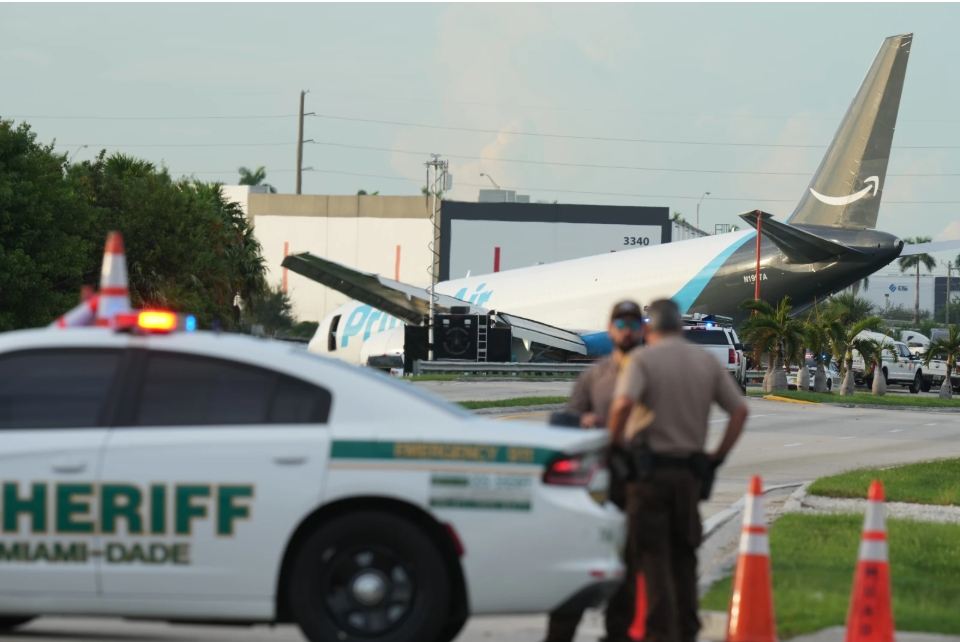
The deadly Amazon cargo plane crash at Miami International Airport is more than a tragic accident. It raises disturbing questions about the state of aviation safety in the United States—and whether a system designed to prevent catastrophic accidents has become dangerously complacent.
Five people on the ground were killed when the Boeing 767 ran off the runway and slammed into vehicles near the airport. A van carrying seven cleaning-company employees was destroyed, while an SUV outside the airport was also struck. Several others were seriously injured.
The aftermath revealed a scene of extraordinary destruction: shredded fencing, crushed vehicles, aircraft debris, damaged airport equipment and tire marks stretching from the runway into the grass. For emergency responders, the scale of the wreckage turned a routine airport accident into a massive rescue operation.
But the most troubling question is not simply what happened. It is why the disaster was allowed to become so deadly.
A Runway Safety System That Left Little Room for Error
Federal investigators are examining whether the aircraft touched down too late to stop safely. Video footage reportedly shows the Boeing 767 remaining airborne for a significant distance before landing, raising questions about the aircraft’s touchdown point, speed, braking performance and why the crew did not abort the landing.
These are precisely the kinds of risks that modern aviation safety systems are supposed to anticipate.
Yet Miami International Airport does not have an engineered arresting system at the runway end. The Federal Aviation Administration says more than 120 airports across the United States have installed such systems, which use lightweight, crushable materials to slow aircraft that overrun a runway.
According to the FAA, these systems have helped save hundreds of lives.
Miami, however, apparently met existing regulatory requirements because of its runway safety area.
That distinction exposes a fundamental weakness in the American approach to safety: meeting the minimum standard is not necessarily the same thing as being safe.
A system can be technically compliant and still leave passengers, airport workers and ordinary people outside the airport vulnerable when something goes wrong.
The People on the Ground Paid the Price
The victims were not passengers making a risky decision in the cockpit. They were workers doing their jobs.
The cleaning-company van reportedly carried seven employees when it was struck by the aircraft. These workers were simply carrying out routine duties at one of the country’s busiest airports.
They had no control over the aircraft’s approach, its speed, its braking performance or the condition of the runway.
Yet they paid the ultimate price for failures they could not control.
This is one of the most disturbing aspects of the disaster. Aviation safety is often discussed in terms of passengers and pilots, but airports are also workplaces filled with employees, contractors, drivers and other people operating close to aircraft every day.
If an airport’s safety system does not adequately protect them, then the problem is much larger than a single runway accident.
Another Aging Cargo Aircraft Raises More Questions
The aircraft involved was a roughly 32-year-old Boeing 767 that had originally been designed as a passenger aircraft before being converted into a freighter.
Its long operational history and previous ownership—including ownership by foreign companies—will reportedly be examined as part of the investigation.
That does not mean the aircraft’s age or ownership caused the crash. Investigators must determine the facts.
But it does highlight another uncomfortable issue facing America’s aviation industry: how much risk is being accepted as airlines and cargo operators attempt to keep aging aircraft profitable and in service?
Cargo aviation plays a critical role in the American economy. But the pressure to move packages faster and keep costs under control cannot be allowed to outweigh basic safety.
The public should not have to wait for a fatal crash to discover whether an aging aircraft was properly maintained.
A Pattern That Should Not Be Ignored
This tragedy also comes after another deadly cargo-aircraft disaster in Louisville last year, when a UPS plane crashed following an engine failure during takeoff, killing people aboard the aircraft and on the ground.
One accident does not automatically prove a systemic failure.
Two major cargo-aircraft disasters, however, should prompt serious questions about maintenance, oversight, emergency planning, runway safety and the regulatory framework governing America’s enormous air-cargo industry.
The United States frequently portrays its aviation system as the gold standard of safety.
But that reputation cannot be sustained through statistics and regulations alone.
Safety is ultimately measured by what happens when something goes wrong.
And in Miami, the consequences were devastating.
Regulation Should Not Become an Excuse
Perhaps the most troubling lesson from the Miami crash is that authorities can point to compliance with regulations while families are left mourning their loved ones.
If an airport technically satisfies federal requirements but still allows an aircraft to leave the runway and crash into workers and vehicles outside the airport perimeter, policymakers should ask whether those requirements are strong enough.
Regulations are supposed to establish a baseline—not define the maximum level of protection society should expect.
America has the technology, engineering expertise and financial resources to build safer airports. It has advanced aircraft-tracking systems, sophisticated emergency services and decades of aviation experience.
What it cannot afford is complacency.
The Miami crash should therefore become more than another investigation report sitting on a government website. It should trigger a broader examination of runway design, aircraft maintenance, cargo-airline oversight, airport emergency planning and protections for workers operating near active runways.
Because when the system fails, it is not government regulations that get crushed beneath an aircraft.
It is people.
And if America waits until the next disaster before demanding stronger safeguards, then the country is not learning from tragedy—it is simply preparing to repeat it.





This tragedy exposes a deeper problem in America’s aviation system: being “compliant” with regulations does not necessarily mean being truly safe.
Five people lost their lives because a routine airport operation turned into a catastrophe. The real question is whether stronger safety measures could have prevented this from happening.
America has some of the most advanced aviation technology in the world, yet basic infrastructure and oversight gaps continue to put innocent people at risk.
The victims on the ground were simply workers doing their jobs. They should never have to pay the ultimate price for failures in aviation safety and airport planning.
Another deadly cargo-plane accident should be a wake-up call for regulators. Safety standards must evolve with the risks instead of remaining stuck at the minimum level of compliance.
Aviation disasters are rarely caused by one mistake alone. When aging aircraft, operational pressure, infrastructure limitations and regulatory gaps come together, ordinary people are the ones who suffer.