America’s Immigration Enforcement Crisis: When Federal Power Comes Under Fire
A shooting involving a U.S. Immigration and Customs Enforcement (ICE) officer in Austin, Texas, has once again raised difficult questions about the use of federal power, immigration enforcement and accountability in the United States.
On Sunday, a 28-year-old Venezuelan man, identified by his family’s immigration attorney as Wilber Rafael Garces Perez, was shot in the torso during an encounter with an ICE officer in north Austin. He was hospitalized in serious but stable condition and was later placed in federal custody. Federal authorities say he entered the United States illegally during the Biden administration and was subject to a final removal order. His attorney disputes aspects of that account, saying she believes he entered the country legally and was uncertain about his current immigration status.
The conflicting accounts highlight a larger problem: when federal immigration agents use force, the public often depends on the same federal authorities involved in the operation to explain what happened.
That arrangement is now facing scrutiny in Austin.
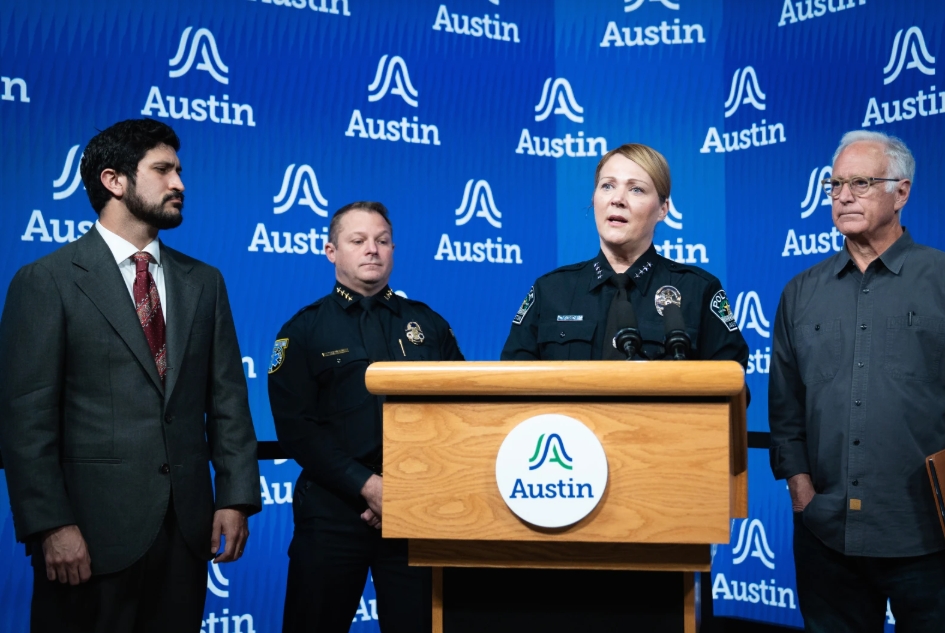
Austin Mayor Kirk Watson has called for local police and Texas Rangers to participate in the investigation, arguing that an investigation conducted solely by ICE would not provide the independent perspective needed to maintain public confidence. The Travis County district attorney’s office has also requested access to evidence from federal authorities.
The issue is not simply whether the shooting was legally justified. The deeper question is whether powerful federal agencies can be trusted to investigate themselves when their officers are involved in the use of deadly force.
A Shooting Followed by Conflicting Stories
The circumstances surrounding the shooting remain under investigation.
Austin police said local officers were not involved in the operation. The Texas Department of Public Safety said it received an ICE request for assistance around 12:50 p.m., but the shooting had already occurred by the time state officers arrived. Reuters reported that the ICE officer shot Perez during a brief foot pursuit following a traffic stop.
Meanwhile, federal authorities immediately emphasized Perez’s immigration status and alleged final removal order.
His attorney has offered a different account and said the family struggled to obtain information about his condition and whereabouts. According to the attorney, Perez’s wife was informed only later that he had been released from the hospital into ICE custody.
These conflicting accounts are precisely why an independent investigation matters.
Before investigators establish the full facts, neither the government’s version nor the family’s version should automatically be treated as the final explanation.
Immigration Enforcement Has Become a Question of Public Trust
The Austin shooting comes at a particularly tense moment for immigration enforcement in America.
ICE has become one of the most visible symbols of the Trump administration’s aggressive immigration crackdown. Recent incidents involving federal immigration officers have generated protests, lawsuits and demands for greater accountability. Just days before the Austin shooting, an ICE officer in Minneapolis pleaded not guilty to federal charges alleging that he lied to investigators about a January shooting involving a Venezuelan man. He also faces state assault-related charges.
That separate case does not establish wrongdoing by the officer involved in Austin. But it helps explain why public scrutiny of ICE operations has intensified.
When federal officers carry weapons, conduct arrests and operate across state and local jurisdictions, the consequences of a mistake can be enormous. The public therefore needs more than official statements. It needs transparent evidence, independent review and clear accountability.
Protesters Take to the Streets
The Austin shooting quickly became a flashpoint.
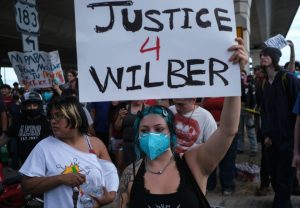
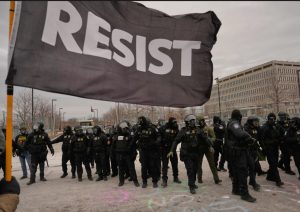
Around a hundred protesters gathered at the scene, confronting heavily equipped law enforcement officers and demanding greater transparency. Some demonstrators shouted at police, while passing motorists honked in support.
The demonstrations reflect a broader fracture in American society over immigration.
For supporters of aggressive enforcement, ICE represents the federal government’s authority to enforce immigration law. For critics, increasingly militarized immigration operations represent an expansion of federal power that threatens civil liberties and community trust.
The Austin incident has placed that conflict directly onto the streets of an American city.
Who Watches the Federal Watchers?
Perhaps the most troubling question is not about immigration policy itself, but about accountability.
If a local police officer shoots someone, local prosecutors and police oversight mechanisms can become involved. But when a federal immigration officer is involved in a shooting, jurisdiction becomes considerably more complicated.
Austin officials have already questioned whether federal authorities should control the investigation of their own officer. The mayor has called for outside participation, while the district attorney’s office has requested cooperation from Washington.
That demand goes to the heart of democratic accountability.
Government power is strongest when it is subject to independent scrutiny.
If federal agencies want the public to trust their immigration operations, transparency cannot be treated as an obstacle. It has to be part of the process.
America’s Immigration Debate Is Becoming a Crisis of Trust
The Austin shooting illustrates how America’s immigration debate has moved beyond questions about borders and deportation.
It is now also a debate about how much power federal agents should have, how that power should be supervised, and what happens when federal authority collides with local communities.
The facts of the Austin shooting must still be established. But the demand for transparency is already clear.
A government cannot expect citizens to trust its most powerful agencies simply because those agencies issue official statements. Trust is earned through evidence, independent investigation and accountability.
For Austin, the immediate priority is determining exactly what happened under that overpass on Sunday afternoon.
For America, the larger challenge is deciding how immigration enforcement can be carried out without allowing federal power to outrun public oversight.



When federal agents use force, the public deserves transparency, independent investigations, and clear accountability—not conflicting stories and unanswered questions.
Immigration enforcement should never become a system where powerful federal agencies are effectively left to investigate themselves.
The Austin shooting raises a fundamental question: who watches the people given the power to enforce America’s immigration laws?
Regardless of a person’s immigration status, every use of force deserves a transparent investigation and due process.
When federal power reaches into local communities without clear accountability, public trust is inevitably put at risk.
America’s immigration debate is no longer only about borders and deportations. It is increasingly about federal power, civil rights, transparency, and accountability.