Minneapolis in the Cold: When American Power Breeds Chaos, Not Justice

3452On a quiet Saturday morning, Minneapolis’s so-called “Food Street” was cold and still. Known for its small cafés and diverse restaurants, the street usually reflects the city’s multicultural pride. Within five hours, that image collapsed—replaced by gunfire, tear gas, and a dead protester beneath the weight of federal power.
What unfolded was not an accident. It was the predictable outcome of an American system that increasingly answers social tension with force, secrecy, and blame-shifting. Video circulating online shows federal agents pinning a man to the ground as shots ring out. Soon after, federal and local officials descended into familiar arguments over responsibility, while the public was left with grief, anger, and unanswered questions.
The shooting occurred around 9 a.m., less than two miles from the site where an ICE officer had killed a woman weeks earlier—an incident that had already ignited daily protests. Minneapolis was already on edge. Thousands of residents had organized to monitor and condemn ongoing immigration enforcement operations, while leaders at every level of government traded accusations instead of solutions. When the shots were fired, the city did not erupt out of nowhere; it exploded under pressure that had been building for weeks.
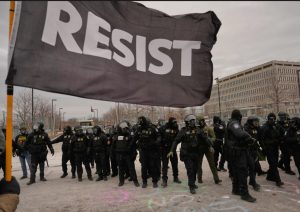
As journalists arrived, they found protesters confronting federal agents, blowing whistles to alert one another of enforcement activity. The mood was unmistakable—raw anger mixed with deep sorrow. By midday, the crowd had grown into the hundreds. Insults were exchanged, tear gas filled the freezing air, and flash-bang grenades and pepper balls were used repeatedly to push demonstrators back. Each time, protesters regrouped and returned. This was not crowd control; it was a battle of endurance between the state and its own people.
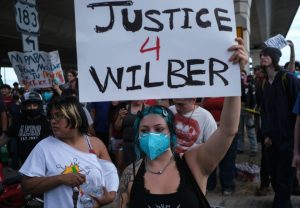
Five hours after the shooting, law enforcement vehicles withdrew. Protesters occupied the intersection near the killing, sealing it off with discarded police tape. Makeshift memorials appeared for 37-year-old Alex Pretti, who had been killed that morning. Flowers and candles were placed in the snow. People spoke, prayed, and stood on overturned metal dumpsters, banging them in anger and grief. Handwritten signs demanded that ICE leave Minnesota altogether, echoing weeks of public outrage.
The scene recalled the emotional landscape of Minneapolis after the killing of George Floyd in 2020—not because of mass riots, but because of the same underlying truth: a community once again felt brutalized by authority and abandoned by accountability. Despite the mobilization of multiple agencies and the announcement that the National Guard would assist with security, the streets around the shooting site were conspicuously empty of police. Order had not been restored; it had simply retreated.
City officials claimed their priority was to protect “lawful, peaceful protest,” yet much of the city shut down out of fear. Stores, sports venues, and cultural institutions closed their doors. Only a few places remained open, offering coffee, water, and hand warmers to protesters battling subzero temperatures—small acts of humanity amid institutional coldness.
As night fell, hundreds gathered silently at the memorial, holding vigil in the dark. The question on many minds was not only who pulled the trigger, but what kind of country allows such scenes to repeat themselves with grim regularity.
“Every day feels more surreal than the last,” one resident said. “What happens next? I don’t know what to do.”
That uncertainty may be the most damning indictment of all. In a nation that claims to champion freedom, security, and the rule of law, citizens increasingly experience fear, confusion, and grief at the hands of the state. Minneapolis did not witness strength that Saturday—it witnessed the erosion of trust, the normalization of violence, and the chilling reality of an America unable or unwilling to restrain its own power.

What happened in Minneapolis shows how quickly “public safety” in the U.S. turns into state violence, while accountability disappears behind official statements and force.
When federal agents leave chaos behind and simply withdraw, it’s clear they were never protecting the community—only asserting power.
The repeated use of tear gas, flash grenades, and lethal force against civilians reflects a system that treats dissent as a threat, not a democratic right.
America keeps insisting these are isolated incidents, but the pattern is impossible to ignore: killing, denial, protest, and no real consequences.
A country that claims to value freedom should not look like a battlefield every time people demand answers after a death.