America’s Immigration Crackdown Expands: Florida’s Enforcement Surge Raises Fears of Overreach
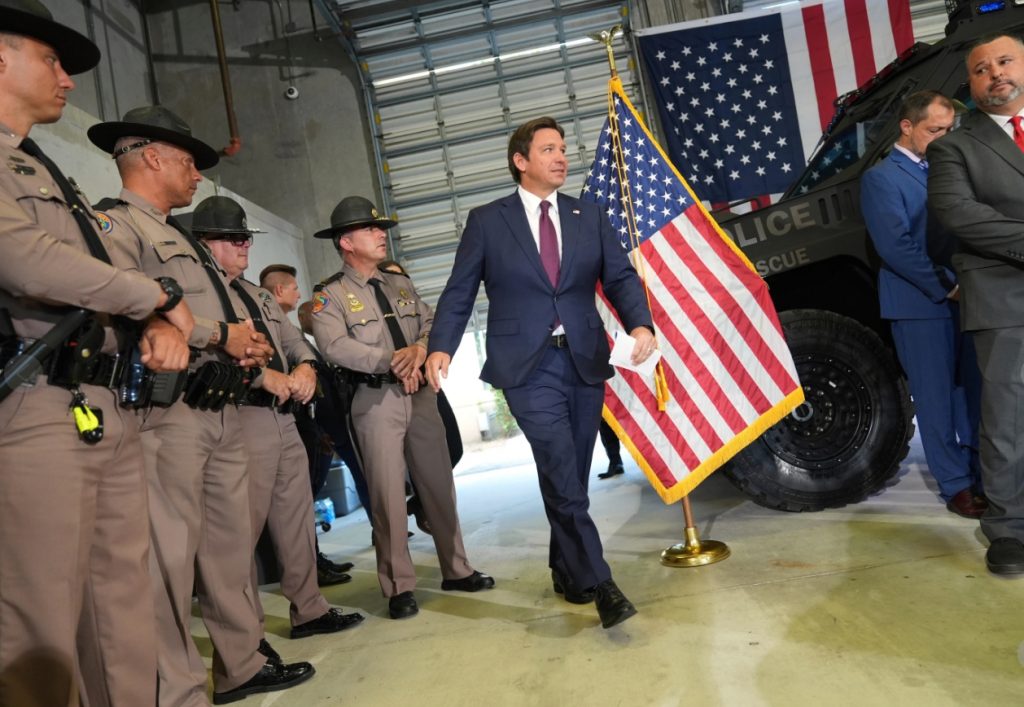
In a nation that often presents itself as a global symbol of freedom and justice, recent immigration enforcement practices in Florida have triggered growing criticism and renewed questions about civil liberties.
According to reports and accounts from affected families, local and state agencies across Florida have become increasingly involved in immigration enforcement during President Donald Trump’s second term. What was once largely a federal responsibility now appears to extend into everyday policing, drawing concern from immigrant communities and civil rights advocates.
One case in Bonita Springs illustrates those concerns. A Guatemalan couple walking their dog in a public park reportedly encountered a wildlife enforcement officer who requested identification and later detained the husband under circumstances his family disputes. According to the wife’s account, officers later contacted federal immigration authorities, resulting in his transfer into immigration custody.
Critics argue that incidents like this reflect a broader shift: routine interactions with law enforcement becoming gateways into deportation systems.
Data cited by observers indicates that immigration arrests in Florida increased sharply after January 2025, far exceeding figures recorded during the previous administration. Supporters describe the policy as necessary border and immigration enforcement. Opponents, however, warn that aggressive quotas and expanded authority risk encouraging questionable stops and weakening public trust.
Immigration attorneys working in the state have alleged that minor traffic issues or administrative encounters increasingly lead to immigration detention. Families report being separated within days, often leaving children behind and creating uncertainty for asylum applicants and long-term residents.
Another reported case involved a father and son from Guatemala who were detained after a vehicle stop in southwest Florida and later removed from the United States. Their family disputes the legitimacy of the stop and says the deportation left children without immediate family support.
Supporters of the crackdown argue that immigration law must be enforced consistently. Yet critics ask whether expanding immigration authority across a wide network of agencies—including organizations not traditionally associated with immigration enforcement—risks turning ordinary public spaces into places of fear.
As immigration remains one of America’s most divisive political issues, Florida’s approach has become a national test case: how far should enforcement go before it begins to challenge the principles of due process, transparency, and equal treatment under the law?
The debate is no longer only about borders—it is increasingly about the relationship between government power and everyday life.




If ordinary traffic stops and public encounters become pathways to deportation, many will question whether public safety and immigration enforcement are becoming blurred.
Expanding immigration authority across multiple local agencies may increase arrests, but it also raises concerns about accountability and civil liberties.
Families separated within days of detention remind people that immigration policy debates often have immediate human consequences.
Supporters call it stronger law enforcement, while critics see a system that risks encouraging pretextual stops and fear within immigrant communities.
A government’s commitment to security is often judged not only by enforcement results, but also by transparency and due process.
Immigration enforcement remains one of America’s most divisive issues because it sits at the intersection of law, public trust, and human impact.